Differential Ring Gear: How It Works & Common Problems

By Weforging Technical Team | Published November 6, 2026

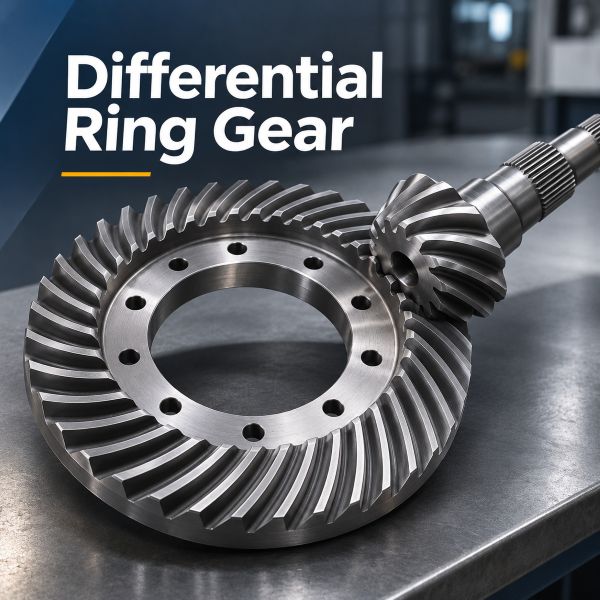
A differential ring gear is the large driven gear in an axle’s final drive assembly, commonly found in rear-wheel-drive vehicles, trucks and some off-highway equipment. Also known as a final drive ring gear or crown wheel, it meshes with the drive pinion to transfer torque, reduce rotational speed and establish the final drive ratio. The ring gear drives the differential carrier, while the internal differential gears allow the wheels to rotate at different speeds.

Differential ring gear and drive pinion with curved teeth, illustrating a final drive gear pair

The differential ring and pinion must work as a matched gear pair. Even when a ring gear meets its dimensional specifications, incorrect tooth contact or assembly conditions can lead to noise and premature wear.

This article explains how differential ring gears work, what causes common gear problems, and how forging and manufacturing quality affect performance.

How Does a Differential Ring Gear Work?

In a typical rear axle final drive, the drive pinion transfers torque to the larger differential ring gear, which turns the differential carrier. The internal differential gears then transmit torque to the axle shafts while allowing the left and right wheels to rotate at different speeds.

The differential ring and pinion form a matched gear pair. Their tooth counts determine the final drive ratio:

Final Drive Ratio = Ring Gear Teeth ÷ Pinion Teeth

For example, a 41-tooth ring gear paired with a 10-tooth pinion produces a 4.10:1 ratio. The pinion turns 4.10 times for each revolution of the ring gear.

Most conventional automotive axle final drives use hypoid gears, with offset, non-intersecting shaft axes. Spiral bevel gears, by comparison, have intersecting axes. These differences affect tooth contact, sliding motion and lubrication requirements.

Because the ring gear and pinion operate as a pair, their tooth geometry and mounting positions must be compatible to maintain proper contact during operation.

Differential Ring Gear vs. Pinion Gear

The differential ring gear is the larger driven gear attached to the differential carrier, while the drive pinion is the smaller driving gear that transfers input torque to it. Although they have different roles, both gears must have compatible tooth geometry and mounting positions to work correctly.

Feature

Differential Ring Gear

Drive Pinion

Function

Drives the differential carrier

Transfers torque to the ring gear

Size

Larger diameter

Smaller diameter

Mounting

Attached to the differential carrier

Supported by pinion bearings

Tooth Geometry

Matched to the drive pinion

Matched to the ring gear

Ring and pinion gears are not interchangeable simply because their diameters and tooth counts are similar. In many automotive hypoid final drives, they are supplied as matched gear sets to achieve the required tooth contact pattern. Replacing one gear independently may result in poor meshing, noise or premature wear.

Why Do Differential Ring Gears Fail?

Differential ring gears can fail because of poor tooth contact, incorrect backlash, inadequate lubrication, excessive loading or material-related defects. These conditions may lead to gear noise, tooth pitting, abnormal wear or, in severe cases, tooth fracture.

However, damage is not always caused by a defective ring gear. The mounting and operating conditions of the complete ring and pinion assembly must also be considered.

Ring and Pinion Tooth Contact and Backlash

A differential ring gear may meet its dimensional specifications but still develop an incorrect tooth contact pattern after assembly.

Ring gear mounting runout, pinion depth, backlash and bearing preload can affect how the mating teeth engage. Excessive runout, for example, may shift the contact toward the tooth edge and increase local contact stress.
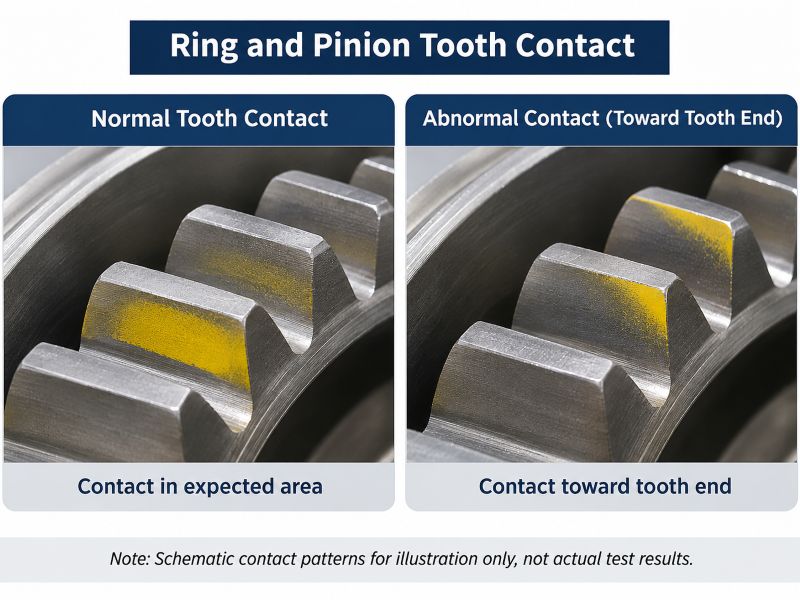
Schematic comparison of normal and edge-biased ring and pinion tooth contact patterns

The acceptable contact pattern depends on the gear design and specified checking conditions. A centered pattern in a simplified illustration should not be treated as a universal acceptance criterion for every hypoid gear set.

Possible failure sequence:

Excessive ring gear runout → Uneven tooth contact → Localized contact stress → Premature tooth wear

Backlash is the clearance between mating gear teeth. Insufficient backlash may cause excessive heat or binding, while excessive backlash can contribute to impact loading and gear noise. The correct clearance depends on the gear set and its assembly specifications.

Tooth contact is commonly checked using marking compound applied to the gear teeth. The resulting contact pattern helps assess gear engagement under the test conditions.

Dimensional inspection confirms individual gear requirements, while tooth contact verification evaluates the assembled gear pair. Both are important, but one cannot replace the other.

Tooth Pitting, Wear and Material Condition

Tooth pitting is a form of contact fatigue caused by repeated stress at or near the tooth surface. Poor lubrication, contamination, misalignment and excessive loading can accelerate surface damage and wear.

Material properties also affect how a differential ring gear performs under repeated loading. Surface hardness, effective case depth and core strength must be appropriate for the intended application. However, hardness alone does not determine gear life; tooth contact and operating conditions remain equally important.

Pitting concentrated near a tooth edge may indicate uneven contact loading, while more widespread surface damage may require closer examination of lubrication, operating loads and material condition. Neither pattern alone establishes the root cause.

When investigating a damaged ring gear, the wear pattern, contact condition, lubrication and material properties should be evaluated together. This helps distinguish assembly-related problems from possible material or manufacturing defects.

How Do Forging and Isothermal Normalizing Affect Differential Ring Gear Performance?

For rear axle differential ring gears, forging and isothermal normalizing are important early manufacturing stages. Forging establishes the ring gear blank, while isothermal normalizing helps control its microstructure and hardness before subsequent machining. Both processes influence manufacturing consistency, but neither replaces final gear cutting, hardening or inspection.

Forging: Blank Quality and Machining Allowance

Differential ring gears operate under repeated tooth loading, making the quality of forged gear blanks important. A controlled forging process helps establish the required blank geometry and material integrity.

For OEM production, the blank must provide sufficient machining allowance for the mounting face, bore and other critical features. Inadequate allowance or internal defects may affect subsequent machining and inspection.

The forging method depends on component geometry and production requirements. Closed-die forging is commonly suited to compact, shaped ring gear blanks. Rolled ring forging may be considered for suitable larger annular blanks, but it is not the standard manufacturing route for every differential ring gear.

Isothermal Normalizing: Microstructure and Hardness Control

After forging, isothermal normalizing can be used to obtain a more consistent microstructure and hardness distribution in the differential ring gear blank.

Compared with uncontrolled cooling after forging, a properly specified isothermal normalizing cycle provides better control over the transformation process. This can improve machinability and reduce variations between blanks before gear cutting.

For OEM production, temperature control, holding conditions, cooling practice and hardness verification should follow the specified material and process requirements. Isothermal normalizing is a preparatory heat treatment; it does not replace subsequent carburizing and hardening where these are required.

After these stages, gear cutting, final heat treatment, finishing and inspection must still be controlled. Distortion during processing can affect the relationship between tooth geometry, mounting face and bore, influencing ring gear runout and tooth contact after assembly.

Similar process controls also apply to other forged transmission components, where material quality, machining accuracy and inspection requirements must be evaluated together.

For differential ring gear projects, the manufacturing route should be determined by the drawing, loading conditions and inspection requirements—not simply the ring gear’s outside diameter.

Conclusion

A differential ring gear must do more than meet its dimensional specifications. Reliable performance depends on the matched ring and pinion gear pair, proper tooth contact, mounting accuracy, lubrication and material condition. A gear that passes individual inspection may still experience noise or premature wear if the assembled gear pair does not mesh correctly.

For OEM manufacturing, suitable forging blanks and controlled machining, heat treatment and inspection help meet the specified gear requirements. Weforging supplies custom ring gear forgings and machined ring components for industrial transmission and heavy equipment applications, according to customer drawings and the agreed manufacturing scope.

What is the ring gear on a differential?

The differential ring gear is the large driven gear in an axle's final drive, attached to the differential carrier. Also called a final drive ring gear or crown wheel, it meshes with the drive pinion to transmit torque and establish the final drive ratio.

What causes differential ring gear damage?

Common causes include poor tooth contact, incorrect backlash, inadequate lubrication, contamination and excessive loading. Material defects or improper heat treatment may also contribute. Checking the contact pattern, backlash, bearing condition and lubrication helps identify the cause of damage.

Are differential ring gears forged?

Yes. Many differential ring gears, particularly those designed for high loads, are manufactured from forged steel blanks. Forging provides the starting material, while subsequent gear cutting, heat treatment and finishing establish the required tooth geometry and material properties. The manufacturing route depends on the gear design and application.

What is the difference between a differential ring gear and an internal ring gear?

A differential ring gear in a conventional automotive axle is typically a spiral bevel or hypoid gear that meshes with a drive pinion to transmit torque through the final drive. An internal ring gear has teeth on its inner circumference and is commonly used in planetary gear systems. The two differ in tooth geometry, mating gears and transmission arrangement.

Table of Contents

Scroll to Top