
Impression Die Forging: What OEM Buyers Should Consider
For OEM buyers, choosing impression die forging is not simply a question of whether a component can be forged. Part geometry, material, production volume, tooling investment, machining requirements, and quality controls all affect whether the process makes technical and commercial sense.
Impression die forging, commonly referred to as closed-die forging, is widely used for repeat-production components that require strength, consistent geometry, and efficient material use. For sourcing teams, the more important question is how the forging process fits the finished part, annual demand, and total manufacturing route.
This article explains the key factors OEM buyers should review before requesting a quote or committing to production.
What Is Impression Die Forging?
Impression die forging forms heated metal between dies containing shaped cavities, or impressions. As the dies close, the material flows to fill the cavity and create the required forged geometry. Depending on the die design, excess material may form as flash and is removed after forging.
The resulting forging is typically closer to the final component geometry than an open-die forged blank. This makes the process well suited to repeat production where material efficiency, consistent shape, and controlled machining allowance are important.
For a more detailed explanation of the forming process, see our guide to Closed Die Forging.
When Is Impression Die Forging the Right Choice for an OEM Part?
Impression die forging is usually most attractive when a component will be produced repeatedly and its geometry can justify dedicated tooling. Typical candidates include load-bearing parts, transmission components, shafts, hubs, flanges, and other industrial components where strength and production consistency matter.
The decision should not be based on production quantity alone. Buyers should compare tooling investment with material utilization, machining time, required mechanical properties, and expected demand over the life of the program.
Good Candidate for Impression Die Forging | Consider Other Manufacturing Routes When |
Repeat or series production | Prototype or very low-volume demand |
Load-bearing component | Simple, lightly loaded component |
Significant material removal from bar stock | Little machining stock would be removed |
Stable component design | Geometry changes frequently |
Near-net-shape forging can reduce machining | Dedicated tooling cannot be economically justified |
For OEM sourcing, the relevant comparison is therefore not only the forging price. For custom metal forgings, buyers should consider tooling, material utilization, machining, quality requirements, and the total cost of producing a conforming finished component.
What Part Designs Are Suitable for Impression Die Forging?
Part design has a direct impact on metal flow, die filling, tool life, and the amount of machining required after forging. A finished-part drawing therefore cannot always be transferred directly into a forging die.
During DFM review, key factors include the parting line, draft, fillet and corner radii, section changes, and machining allowance. Sharp internal corners or abrupt changes in section can restrict material flow, while sufficient allowance must remain on precision bores, bearing seats, sealing surfaces, and other features that require final machining.
At Weforging, these factors are reviewed from the finished drawing and 3D model before tooling is released. Die geometry, preforming, material flow, and downstream machining requirements are considered together.
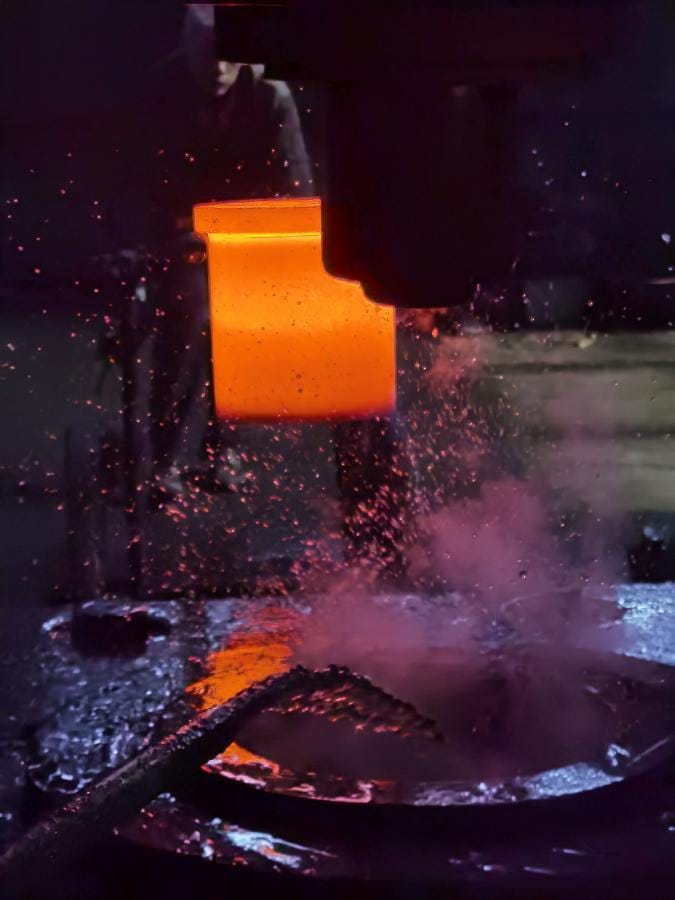
Production control also matters after the tooling is developed. During hot forging, die cooling and lubrication are applied between forging cycles to support stable forming conditions and protect the working die surfaces, as shown in the Weforging production image below.
How Do Tooling and Production Volume Affect Forging Cost?
Impression die forging requires dedicated tooling, so tooling investment is an important part of the sourcing decision. However, comparing tooling cost alone can give a misleading picture of project economics.
As production continues, the tooling investment is distributed across more components. A well-designed near-net-shape forging can also reduce raw-material waste and the amount of metal removed during CNC machining.
Total cost still depends on material grade and billet weight, part complexity, number of forming operations, die complexity, annual volume, heat treatment, machining scope, and inspection requirements.
For this reason, there is no universal minimum order quantity at which impression die forging becomes economical. A sourcing review should consider expected annual demand and program life together with tooling and finished-part cost.
Buyers comparing quotations should also confirm what is included. A low forging price may not include heat treatment, CNC machining, NDT, or final dimensional inspection.
Buyers evaluating different manufacturing routes can also review the main factors that affect forging cost, including material, tooling, production volume, heat treatment, machining, and inspection.
How Much CNC Machining Is Needed After Impression Die Forging?
Impression die forging is a near-net-shape process, so many OEM components still require CNC machining to achieve final dimensions, tolerances, and functional surfaces.
Typical machined features include precision bores, bearing seats, threads, sealing surfaces, datum faces, tight-tolerance diameters, and assembly interfaces. The amount of machining depends largely on the forged blank design: excessive allowance increases machining time and material removal, while insufficient stock can make final dimensions difficult to achieve consistently.
At Weforging, the forged blank, machining allowance, datums, heat-treatment sequence, and final tolerances are reviewed as one manufacturing route before production.
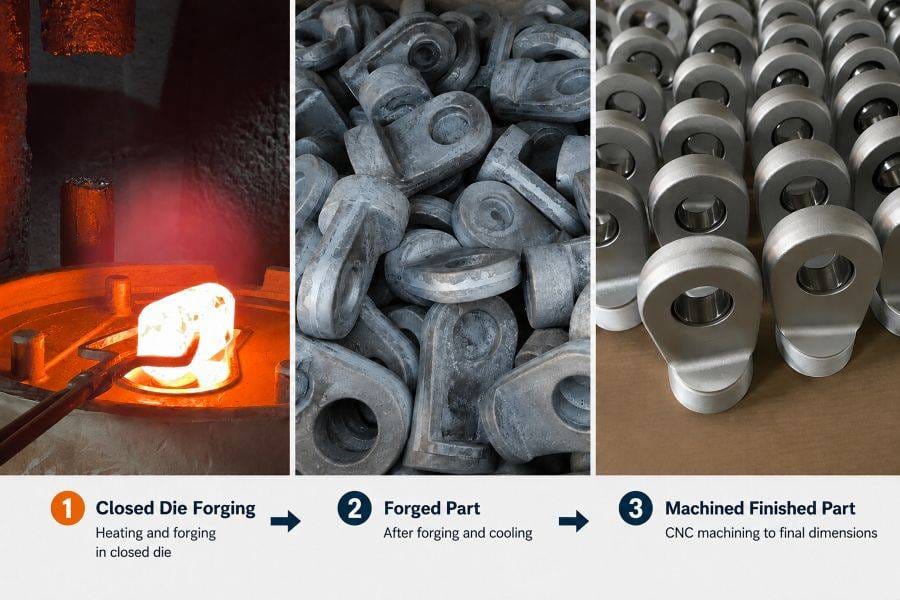
Closed Die Forging → Forged Part → Machined Finished Part
This integrated approach is particularly valuable for machined forgings supplied as finished OEM components, where forging geometry, machining allowance, and final tolerances must be planned together.
What Materials and Heat Treatment Requirements Should Buyers Define?
Material selection should start with the service requirements of the finished component, not simply with what is easiest to forge.
When preparing an RFQ, buyers should define the required material grade or applicable specification whenever it is already established on the drawing. Depending on the project, specifications may reference ASTM, SAE/AISI, EN/DIN, or other customer-approved standards.
Heat treatment and required mechanical properties should also be identified. These may include hardness, tensile strength, yield strength, elongation, or impact properties where relevant to the application.
If the drawing specifies performance requirements but leaves material or heat-treatment details open, these requirements should be reviewed before tooling is released.
For long-term OEM programs, material, heat treatment, machinability, and final mechanical properties should be evaluated together rather than as separate purchasing items.
What Quality Requirements Should OEM Buyers Specify?
Why Does an Integrated Forging and Machining Supplier Matter?
A forged component may pass through several operations before it becomes a finished OEM part. When forging, heat treatment, machining, and inspection are managed by separate suppliers, each handoff introduces another drawing interpretation, production schedule, and quality record to coordinate.
An integrated manufacturing route reduces these interfaces.
More importantly, decisions made at the forging stage can account for downstream requirements. Forging stock can be planned around CNC machining; heat treatment can be sequenced around material and dimensional requirements; inspection can be based on the same finished drawing used to plan production.
Weforging combines custom forging, CNC machining, heat-treatment coordination, and inspection for OEM components. This model is particularly useful when buyers require a finished component rather than an unfinished forging blank.
For procurement teams, the benefit is not simply having fewer suppliers. It is clearer responsibility for the complete manufacturing route and continuous traceability from raw material to final inspection.
From OEM Drawing to a Finished Impression Die Forged Component
For a custom project, the manufacturing route should be developed backward from the finished component requirements rather than treating forging as an isolated operation.
Weforging coordinates the complete manufacturing route:
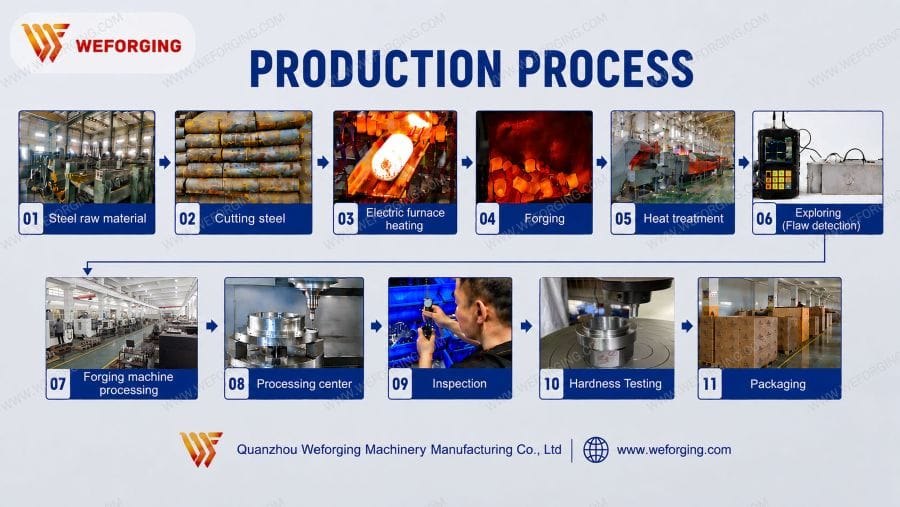
OEM Drawing / 3D Model → DFM & Process Review → Material & Technical Requirement Confirmation → Tooling Design & Manufacturing → Raw Material & Billet Cutting → Heating & Preforming → Impression Die Forging → Flash Trimming / Cleaning → Heat Treatment → CNC Machining → Dimensional & Quality Inspection →Finished OEM Component
This approach allows tooling, forging allowance, heat treatment, machining, and inspection requirements to be considered before series production begins.
What Should Buyers Include in an Impression Die Forging RFQ?
A complete RFQ helps the supplier evaluate manufacturability, tooling, and finished-part cost without repeated clarification.
For a new OEM component, buyers should provide the 2D drawing and 3D model when available, together with the material specification, heat-treatment requirements, mechanical properties, critical tolerances or GD&T, surface requirements, estimated annual volume, and expected batch quantity.
Special requirements for NDT, dimensional reporting, PPAP, or other customer documentation should also be identified before quotation.
If a forging blank has not yet been designed, that is not necessarily a problem. The finished component drawing can be used as the starting point for DFM review and development of the forging and machining route.
For custom impression die forged parts, send the finished drawing and expected annual quantity for a manufacturability and quotation review.