
Multi-Stage Forging: Process, Forming Sequence and Design
By Weforging Technical Team | Published November 20, 2026
Multi-stage forging shapes metal through successive forming operations rather than a single step. Depending on the material and part geometry, the process may involve upsetting, extrusion, preforming or die forging under cold or hot working conditions.
For complex components, the challenge is deciding how to distribute material between stages, control deformation and determine which features require final machining. A poorly planned forming sequence can lead to incomplete die filling, folding or excessive tooling loads.
This article examines how forming sequences are developed, where problems can arise and what OEM engineers should consider when designing parts for multi-stage forging.
What Is Multi-Stage Forging?
Multi-stage forging is a metal forming process that uses two or more successive deformation operations to produce a required part geometry. Each stage prepares the workpiece for the next, allowing complex features to be formed without concentrating all deformation in a single operation.
Multi-stage refers to the forming sequence, while multi-station describes equipment with multiple forming stations. A multi-stage process can be carried out on one machine or across several machines, depending on the production setup.
How Does Multi-Stage Forging Work?
Multi-stage forging starts with a billet or slug of controlled volume. The workpiece then passes through successive forming operations, with each stage preparing its shape and material distribution for the next.
A typical forming sequence may include:
- Preforming:Redistributing material through operations such as upset forging to prepare for subsequent deformation.
- Intermediate forming:Using upsetting, extrusion or die forming to develop stepped sections, flanges or other required features.
- Final forming:Bringing the workpiece closer to its specified geometry, with additional sizing, trimming or piercing where required.
The sequence varies with the material, part geometry and tooling. A cold-forged hollow component, for example, may require a different combination of operations from a hot-forged nut-type part. Critical dimensions or surfaces may still require CNC machining after forging.
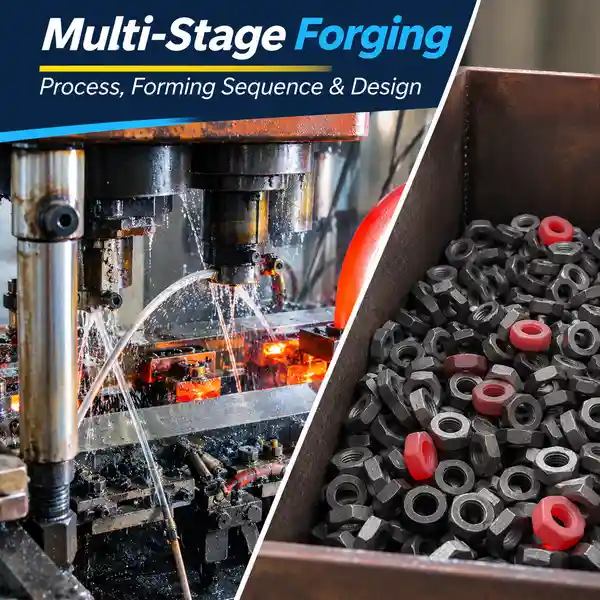
Multi-stage hot forging of a nut-type component at Weforging, showing successive forming operations in actual production.
Multi-Stage Cold Forging vs Hot Forging
Both cold and hot forging can involve multiple forming stages. The main differences lie in material flow stress, deformation limits, tooling requirements and dimensional control.
Factor | Multi-Stage Cold Forging | Multi-Stage Hot Forging |
Temperature | Usually near room temperature | Above the material’s recrystallization temperature |
Forming load | Higher flow stress generally increases forming loads | Heating reduces flow stress and can allow greater deformation |
Dimensional control | Often offers better as-forged accuracy and surface finish | Must account for thermal contraction, scale and temperature variation |
Process limitations | Work hardening, die stress and lubrication | Oxidation, temperature control and die wear |
Forming sequence | Deformation per stage may be limited by ductility and tool loads | Greater deformation may be feasible, but temperature loss between stages must be controlled |
Cold forging may be suitable when the required geometry can be formed within the material’s ductility and tooling limits. Hot forging may be preferable when large section changes or high forming loads make cold forming impractical. The choice also depends on production volume, tooling cost and subsequent machining requirements.
For more on cold forming principles, see Weforging’s cold forging guide.
How Is the Forming Sequence Designed?
Forming sequence design starts with the finished part requirements. Engineers review the geometry, material volume, section changes and tooling limits to determine which features can be formed at each stage.
The aim is to achieve the required geometry while controlling material flow, forming loads and tooling complexity.
How Many Forming Stages Are Needed?
There is no fixed number of stages for a given component type.
A part with a large flange and a narrow shaft section may need a separate upsetting operation to accumulate material for the flange. Trying to form the entire geometry in one step may create excessive local strain or exceed tooling and press limits.
Adding another stage can reduce the deformation required in a single operation, but it also increases tooling and transfer requirements. The number of stages must therefore be balanced against material formability, equipment capacity and production cost.
Preform Design and Material Flow
A preform is not simply a smaller version of the finished part. Its geometry determines where material is available for subsequent deformation.
In closed die forging, insufficient material near a flange region may lead to incomplete die filling, even when the total billet volume is correct. Increasing the billet volume alone may not solve the problem if the material is poorly distributed.
Preform design must therefore account for both material volume and its distribution before the next forming operation.
When Should Holes and Steps Be Formed?
The timing of hole and step formation depends on the geometry, material and tooling arrangement.
Backward extrusion can produce a cavity without immediately removing material, while other components may require piercing after upsetting or drilling during final machining.
Forming a hole too early can complicate subsequent deformation or tooling support. Delaying hole formation may leave a thicker section to pierce or increase machining requirements.
The sequence should be selected according to wall thickness, tooling access and final tolerance requirements rather than the number of available stations.
Common Multi-Stage Forging Defects
Defects found after the final forming stage may originate in an earlier operation. Incorrect preform geometry, unstable material flow or inconsistent workpiece positioning can affect subsequent stages.
Defect | Possible Cause | What to Check |
Folding or laps | Material folds over itself during deformation | Preform shape, die geometry and flow direction |
Incomplete die filling | Insufficient local material, low forming temperature or inadequate load | Billet distribution, temperature and die filling |
Cracking | Excessive local strain or insufficient material ductility | Deformation per stage, material condition and forming temperature |
Die wear or failure | High contact stress, friction or thermal cycling | Tool condition, lubrication and forming loads |
Dimensional variation | Die wear, temperature changes or inconsistent workpiece positioning | Intermediate dimensions, transfer alignment and process stability |
When a defect appears in the finished forging, the last forming die is not necessarily the source. Comparing intermediate workpiece shapes and checking the earliest stage where a deviation appears can help identify the cause before adjusting the final tooling.
Multi-Stage Forging for OEM Components
Multi-stage forging is suitable for selected components with significant section changes, flanges, stepped diameters or internal features. Applications include nut-type parts, fasteners, stepped shafts and hollow components.
For OEM production, manufacturing feasibility should be reviewed before tooling design. Key questions include:
- Can the specified material and geometry accommodate the required deformation?
- Which features can be forged near net shape, and which require final machining?
- Does the production volume justify the tooling investment?
- Which dimensions require control through forging, heat treatment and machining?
For example, a stepped shaft may need machining allowance on its bearing seats to achieve final tolerances. A nut-type component may require a different combination of upsetting, cavity formation and finishing operations, depending on its geometry.
At Weforging, our custom forging capabilities cover cold and hot forging for OEM components. Forging requirements are reviewed together with CNC machining allowances, critical dimensions and inspection needs, rather than treating each operation as a separate manufacturing decision.
How Are Multi-Stage Forgings Inspected?
Final dimensional inspection verifies whether a forging meets its specified dimensions, but it may not reveal defects introduced during earlier forming stages.
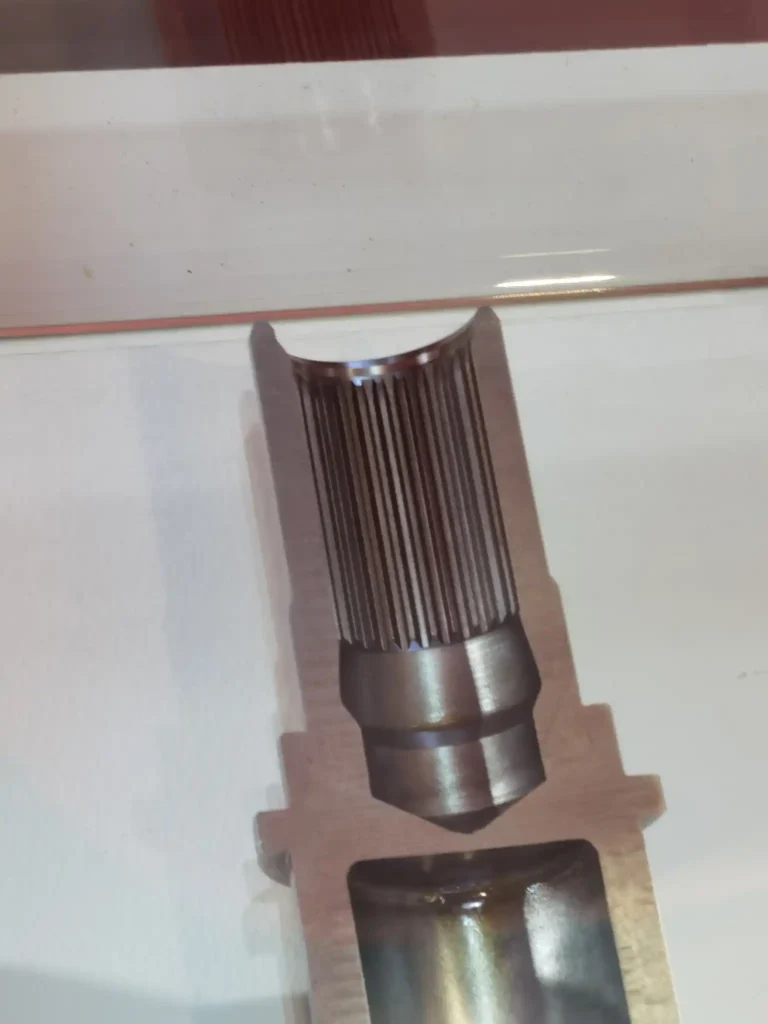
During process development, intermediate workpieces can be checked for incomplete die filling, folding and unexpected deformation. For components with internal features that are difficult to measure directly, sectioning may be necessary to verify their geometry.
For example, Weforging sectioned a multi-stage forged motor shaft component for new energy equipment to verify its internal geometry.
The exposed cross-section allows internal profiles and stepped dimensions to be checked using optical projection measurement—features that are difficult to access from the outside.
For batch production, inspection includes first-piece verification and periodic in-process checks. Additional tests, such as hardness measurement, metallographic examination or nondestructive testing, are selected according to the drawing requirements and process risks.
At Weforging, inspection covers both finished-part requirements and manufacturing consistency, rather than relying solely on final dimensional checks.
Conclusion
Have a component with stepped diameters, flanges or internal cavities that may require multiple forming stages?
Send Weforging your drawing, material specification and estimated production quantity. Our engineering team can review the feasibility of multi-stage cold or hot forging, including forming sequence, machining allowances and inspection requirements.